Featured Low-E & Security Entrance Systems
Direct factory-engineered entrance systems designed for extreme thermal isolation, anti-burglary protection, and modern architectural aesthetics in the Netherlands.
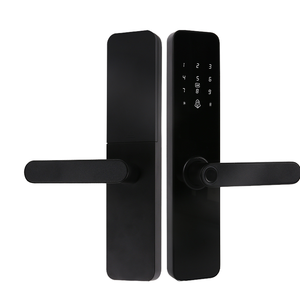
TTLOCK Smart WiFi Lock Aluminum Alloy Wood Door Fingerprint Password Electronic Door Lock Tuya App Cloud Storage Grade Security
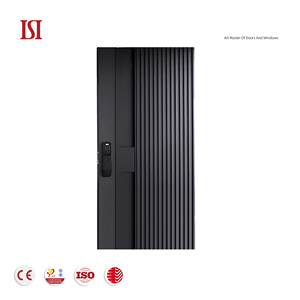
European Luxury Entrance Doors with Anti-Theft Security Modern Residential Exterior for Luxury Villas Manual Opening
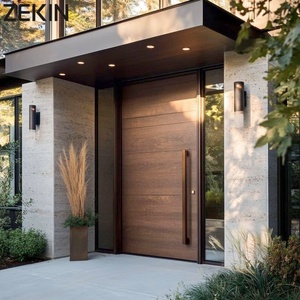
ZEKIN Modern American Design House Heat Insulation Fire Prevention Luxury Entrance Pivot Door House Front Entry Doors
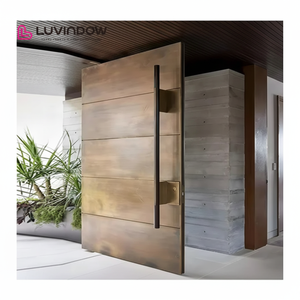
American Style Contemporary Solid Wood Entry Main Entrance Wooden Doors Front Doors for Houses Modern Exterior Main Pivot Door
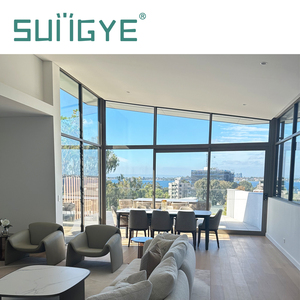
SUNGYE Residential Australian Seaside Villa Project Black Aluminum Panoramic Sliding Door Windproof Double Glass Entrance Door
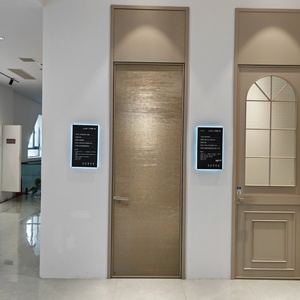
Slim Frame Laminated Glass Security Door Impact Proof Metal with Minimalist Design for Kitchen & Bathroom
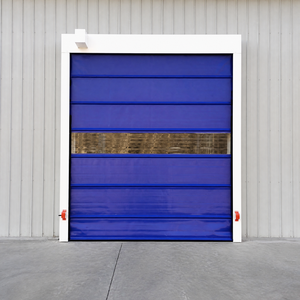
Rapid Stacking Door High Speed PVC Industrial Door Automatic Folding Security Gate Wind Resistant for Warehouse Entry
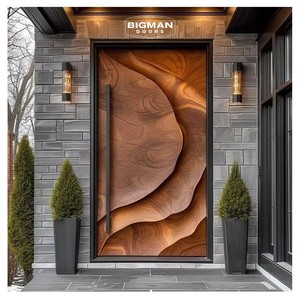
American Luxury Villa Solid Wood Black Walnut Front Entry Carved Exterior Modern Door Entrance Main Door For Houses
Low-E Fenestration Engineering for the Netherlands Market
The Dutch architectural and construction sectors operate under some of the most rigorous energy efficiency and security mandates in the European Union. With the enforcement of the Besluit bouwwerken leefomgeving (BBL 2024) and the NTA 8800 energy calculation method, thermal envelope integrity has evolved from a simple building preference into a legally binding requirement for architects, developers, and fenestration importers across the Netherlands.
Front entrance doors represent one of the most critical thermal bridge risks within residential and commercial building envelopes. Located at latitude 52°N, the Dutch maritime climate imposes severe weather conditions: high humidity, driving North Sea wind pressures, low winter solar angles, and frequent freeze-thaw cycles. Importing standard, uninsulated fenestration leads to severe condensation, air leakage, structural frame deformation, and failure to meet the strict Energieprestatie-coëfficiënt (EPC) targets.
Primary Market Requirement: Dutch B2B project specifiers demand complete entrance systems achieving an overall thermal transmittance ($U_d$) of $\le 1.0 \text{ W/m}^2\text{K}$, coupled with certified burglar resistance under NEN 5087 (Politiekeurmerk Veilig Wonen - PKVW) with SKG** or SKG*** hardware integration.
Core Dutch Procurement Benchmark Checklist
- Thermal Performance: Low-E double/triple glazing with Argon fill ($U_g \le 0.5 - 0.7 \text{ W/m}^2\text{K}$).
- Profile Construction: Multi-chamber extruded 6063-T6 aluminum with 24mm to 34mm PA66 GF25 thermal break strips.
- Acoustic Attenuation: Noise reduction index ($R_w \ge 40 - 42 \text{ dB}$) for high-density urban areas like Amsterdam, Rotterdam, and Utrecht.
- Coastal Corrosion Resistance: Surface treatment meeting Qualicoat Class 2 / Seaside standards for coastal exposure in Zeeland and North Holland.
- Smart Locking Integration: Automated multi-point motor locks compatible with Tuya, TTLock, and commercial building management systems (BMS).
Physics of Magnetron Sputtered Low-E Coatings in Dutch Latitudes
Understanding the precise electromagnetic radiative control of Low-Emissivity glass coatings engineered specifically for Northwestern Europe.
MSVD Soft Coating Technology
Unlike traditional Pyrolytic hard-coat glass, Primor utilizes multi-layer Magnetron Sputtered Vacuum Deposition (MSVD) soft coatings. Microscopic metallic silver ($Ag$) layers embedded between dielectric metal oxides reflect long-wave infrared (heat energy) back inside the house during cold Dutch winters while allowing visible light ($VLT \ge 72\%$) to illuminate living spaces.
Solar Heat Gain (SHGC) Balancing
In the Netherlands, solar heat gain strategy differs drastically from Southern Europe. Our Low-E double and triple glass units are calibrated with a balanced Solar Heat Gain Coefficient ($SHGC \approx 0.45 - 0.55$). This prevents summer overheating while optimizing passive solar heat gain during low-angle sunlight months (October through April).
Warm Edge & Argon Gas Cavities
Thermal isolation is reinforced by 90%+ pure Argon gas filling within 16mm to 20mm glass cavities. We utilize Swisspacer Ultimate / TGI composite warm-edge spacer bars, eliminating the perimeter cold-bridge vector that causes perimeter glass condensation and interior mold growth in damp Dutch residences.
| Glazing Specification | Overall Thickness | Center Glass $U_g$ (W/m²K) | Overall Door $U_d$ (W/m²K) | VLT (%) | Acoustic Rating ($R_w$) |
|---|---|---|---|---|---|
| Double Low-E + Argon (6LowE + 16Ar + 6 Tempered) | 28 mm | 1.1 W/m²K | 1.15 - 1.25 W/m²K | 76% | 36 dB |
| Triple Low-E + Argon (6LowE + 14Ar + 6 + 14Ar + 6 LowE) | 46 mm | 0.6 W/m²K | 0.82 - 0.92 W/m²K | 70% | 40 dB |
| Acoustic Laminated Triple Low-E (6.38 Soundproof + 14Ar + 6 + 14Ar + 6LowE) | 52 mm | 0.5 W/m²K | 0.78 W/m²K | 68% | 44 dB |
Bespoke Fenestration Deployment Across the Netherlands
Tailoring door engineering parameters to localized Dutch microclimates, urban density constraints, and regional architectural aesthetics.
North Sea Coastal Villas (Zeeland, Texel, Scheveningen)
Environmental Challenge: Severe salt-spray marine environment (C5-M corrosion rating), saline humidity, and extreme wind pressures exceeding 1.8 kPa during North Sea winter storms.
Factory Solution: Heavy-duty thermal break entrance pivot and hinged door systems utilizing 6063-T6 aluminum treated with Qualicoat Seaside Class 2 anodized powder coatings (60–80 μm thickness). Glass panels feature double-laminated impact safety Low-E glass rated for EN 12210 Class C5 wind resistance and Class E1050 water tightness.
Historic Urban Canal Renovations (Amsterdam, Utrecht, Leiden)
Environmental Challenge: Narrow facade footprints, strict municipal aesthetic heritage guidelines, and high ambient noise pollution from tramways and urban pedestrian traffic.
Factory Solution: Ultra-slim sightline aluminum entrance doors with simulated divided lites (SDL) matching classic Dutch brickwork aesthetics. Integrated double acoustic PVB laminated Low-E glass delivers noise suppression up to $R_w = 42\text{ dB}$, isolating city noise while complying with urban energy retrofits.
Sustainable Suburban Developments (Eindhoven, Almere, Amersfoort)
Environmental Challenge: Zero-energy housing mandates under BBL 2024 requiring strict airtightness (Blower Door test compliance $n_{50} \le 0.6 \text{ h}^{-1}$).
Factory Solution: Quadruple-sealed thermal break aluminum front doors filled with high-density polyurethane insulation cores ($45 \text{ kg/m}^3$) combined with triple Low-E vacuum glass. Reaches an exceptional $U_d \le 0.78 \text{ W/m}^2\text{K}$, enabling BREEAM-NL Outstanding ratings.
Commercial & Logistics Hubs (Rotterdam Port, Schiphol District)
Environmental Challenge: Heavy commercial foot traffic, industrial vehicle vibration, structural wind deflection, and emergency egress regulations (EN 179 / EN 1125).
Factory Solution: Heavy-gauge reinforced aluminum storefront doors and high-speed automatic industrial stacking doors. Heavy-duty 3D adjustable stainless steel hinges tested to 500,000 opening cycles with panic-bar hardware integration.
Key Localized Fenestration Trends in the Netherlands
Strategic insights into technology adoption, security standards, and material circularity driving Dutch architectural purchasing decisions.
Mandatory SKG*** Burglar Protection
Dutch buyers rarely accept standard entry locks. Under PKVW rules, entrance doors require 3-point or 5-point motorized hook locking systems certified to SKG*** (Stichting Kwaliteit Waarborg Bouw), featuring anti-drill plates and anti-core pulling cylinder guards.
Smart IoT Access & Cloud Integration
Residential entrance door procurement is shifting rapidly toward keyless smart entry. Integration of Tuya Smart, TTLock, Apple HomeKit, and RFID biometric scanners directly into the thermal break door profile handle is now a standard requirement in high-end Dutch housing projects.
Circular Aluminum & EPD Verification
The Dutch construction industry prioritizes circular economy principles. Extruded aluminum frames with high recycled alloy content and certified Environmental Product Declarations (EPD) allow project developers to gain points in national MIA/VAMIL environmental tax incentive schemes.
Why Partner with Primor Metal Door Co., Ltd.
Primor Metal Door Co., Ltd. is a specialized global manufacturer of custom aluminum windows, architectural entry doors, sliding systems, pergolas, and glass sunrooms equipped with advanced thermal break technology.
Unlike commodity suppliers operating strictly off fixed stock catalogs, Primor builds 100% of its fenestration orders to measure based on architectural DWG drawings, structural engineering schedules, and regional climate requirements. We maintain full control over the production supply chain, from profile extrusion and polyamide strip insertion to CNC machining, double/triple Low-E glazing assembly, and final export crating.
B2B Project Guarantee: Every door system destined for the Netherlands undergoes factory pre-assembly testing, air/water tightness verification, micro-tolerance corner crimping inspections, and multi-point lock calibration before container loading.
Factory Operations & B2B Support Matrix
Bespoke CAD / BIM Shop Drawings
Our engineering department issues full CAD shop drawings and section details for architect approval prior to cutting a single profile.
Strict Quality Assurance & CE Marking
Compliance with EN 14351-1 standards, ensuring smooth customs clearance and regulatory approval throughout the EU.
Heavy Export Crating & Direct Sea Freight
Sealed wooden crates with foam edge protectors and moisture-absorbing desiccant packs shipped directly to Rotterdam Port.
Frequently Asked Questions by Dutch B2B Importers
Direct engineering answers regarding compliance, thermal metrics, logistics, and customization for the Netherlands market.
What specific U-value ratings can Primor Low-E glass front doors achieve to satisfy Dutch NTA 8800 standards?
Primor thermal break aluminum front doors achieve overall door transmittance ratings ($U_d$) ranging from 0.78 W/m²K to 1.1 W/m²K depending on the profile series and glazing configuration. By pairing our 34mm PA66 GF25 polyamide thermal break profiles with triple-pane Low-E glass (with 90% Argon gas cavity fill and Swisspacer warm-edge bars), our systems comfortably exceed the Dutch BBL 2024 minimum requirement of $1.4 \text{ W/m}^2\text{K}$ for new residential constructions.
Are Primor entry door lock mechanisms compatible with Dutch SKG*** and NEN 5087 security requirements?
Yes. We factory-integrate multi-point hook locking gear (3-point or 5-point locking) specifically engineered to accept European profile cylinders rated for SKG** and SKG*** (Stichting Kwaliteit Waarborg Bouw) standards. This provides the anti-core pulling, anti-drill, and frame-interlocking strength required to achieve the Dutch Politiekeurmerk Veilig Wonen (PKVW) residential safety certificate.
How do your aluminum Low-E entrance doors resist maritime salt spray along coastal regions like Zeeland and North Holland?
For projects in Dutch coastal windward zones, we apply Qualicoat Class 2 / Seaside architectural powder coatings or heavy-duty anodized finishes with a layer thickness of 60 to 80 microns. Coupled with marine-grade 316 stainless steel hinges, EPDM weather-sealing gaskets, and sealed Low-E glass edges, our doors achieve a C5-M corrosion rating, preventing oxidation, surface pitting, and finish degradation under harsh saline conditions.
Can Primor supply custom door dimensions and bespoke glass patterns for historic canal house renovations in Amsterdam?
Absolutely. Every entrance system manufactured by Primor is 100% made-to-measure. We regularly manufacture custom non-standard door heights up to 3.5 meters, arch-top entry frames, side-lite integrations, and simulated divided lite (SDL) glass bars designed to match historical Dutch urban facade conservation rules while delivering modern Low-E thermal performance.
What is the typical lead time for custom manufacturing and ocean container delivery to Rotterdam Port?
Our standard production lead time for custom thermal break Low-E entrance doors is 25 to 35 days following CAD shop drawing approval. Ocean freight shipping from our factory to the Port of Rotterdam or Amsterdam Port takes approximately 28 to 35 days. We coordinate full export packing, CE documentation, and customs filing support for Dutch importers and project contractors.
Does Primor support smart lock integration (Tuya, TTLock, RFID) into thermal break Low-E front door systems?
Yes. We offer fully integrated smart access solutions including Tuya App, TTLock WiFi/Bluetooth modules, biometric 3D fingerprint handles, and digital keypad entry locks. These electronic components are thermally isolated from the exterior profile to prevent heat transfer and internal condensation within the lock body, guaranteeing reliable operational performance in cold European winters.
Ready to Spec Low-E Entrance Doors for Your Netherlands Project?
Contact Primor Metal Door Co., Ltd. today. Submit your architectural CAD drawings or fenestration schedule to receive an engineering feasibility review, U-value calculation report, and factory-direct price quotation.