Precision Aluminum Entrance Systems for B2B Importers & Projects
Explore our export-ready collection of coastal-rated aluminum entry doors, designed to withstand rigorous wind loads, water penetration, and thermal transfer requirements across Central Europe and the Czech Republic.
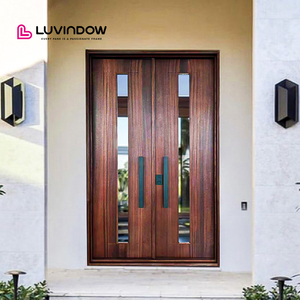
Custom Villa Modern Solid Wood & Pivot Aluminum Entry Door
Heavy-duty structural pivot system integrating engineered timber veneers with marine-grade aluminum frame reinforcing.
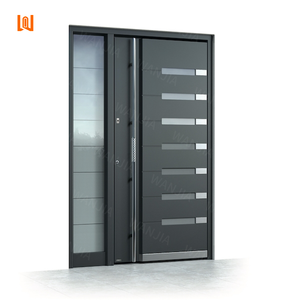
Stylish Double Glazed Stormproof Aluminum Entry Door
High-pressure double compression sealing strips designed for intense rain storms and high wind load resistance.
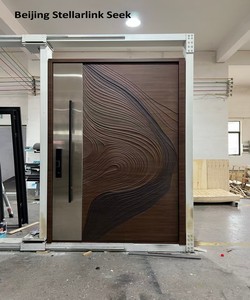
Modern Luxury Wood Grain Relief Panel Aluminum Door
Sculptural relief panel entrance with insulated side lights and heat-transfer wood grain powder coating.
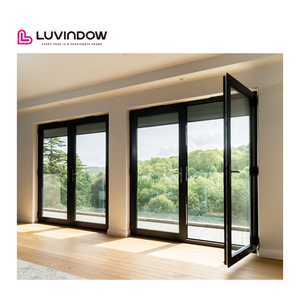
Premium Double Glass Coastal Hurricane-Resistant Door
Reinforced aluminum alloy structural frame with laminated impact-resistant glass for severe wind resistance.
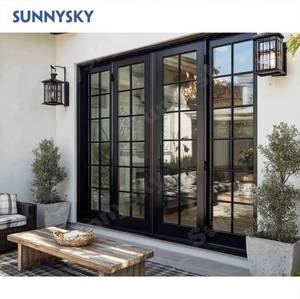
Commercial & Villa Double Glazed French Swing Entrance Door
Dual-leaf symmetrical French opening design featuring thermal break profiles and multi-point hardware locks.
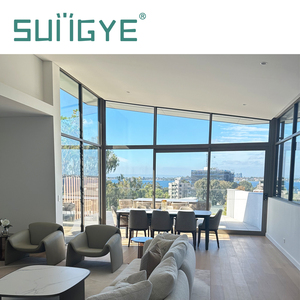
Seaside Villa Black Aluminum Panoramic Entrance Door System
Ultra-slim interlock profiles offering unobstructed panoramic views with high salt-spray corrosion protection.
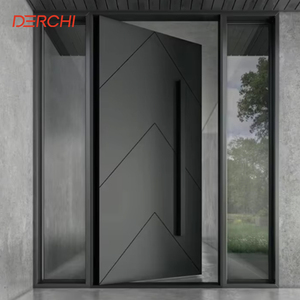
Customized Heavy Duty Residential Front Entry Impact Door
Thickened 3.0mm wall profile engineering built for luxury residential front facades requiring high security.
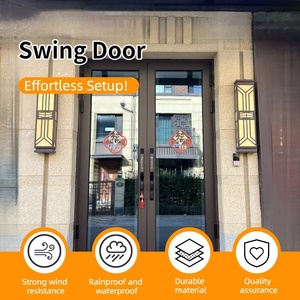
Modern Minimalist Coastal Double Glass Swing Entry Door
Flush architectural lines paired with advanced low-E insulating glass for energy efficiency and weather tightness.
High-Capacity Coastal Manufacturing & Supply Standards
Bridging global manufacturing capacity with European building code compliance for architects, general contractors, and door importers in the Czech Republic.
RC3 Security Rating
Multi-point automatic locking mechanisms, heavy-duty anti-lift pins, and reinforced hinge plates certified according to EN 1627-1630 standards.
Thermal Insulation (Ud ≤ 0.8)
Integrated PA66 GF25 polyamides thermal break strips combined with triple-pane Low-E glazing, fulfilling Nová Zelená Úsporám passive house criteria.
C5 Marine Corrosion Resistance
Qualicoat Class 2 & Class 3 fluoropolymer powder coatings rated for 3,000+ hours of continuous salt-spray testing per ISO 9227 standards.
Coastal Aluminum Entry Door Manufacturing: A Structural & Thermal Analysis for the Czech Market
In contemporary European architectural engineering, entry doors are no longer evaluated purely on aesthetic appeal. As building codes across the European Union undergo rigorous decarbonization mandates under the Energy Performance of Buildings Directive (EPBD), the architectural entrance envelope has transformed into a complex thermal, structural, and mechanical barrier. For developers, importers, and architects operating within the Czech Republic—ranging from the urban developments in Prague and Brno to high-humidity riverine estates along the Vltava basin and alpine microclimates in Krkonoše—specifying the correct entry door manufacturing system requires balancing high material durability with ultra-low thermal transmittance ($U_d$).
Although the Czech Republic is landlocked, Central European river basins, humid microclimates, winter road salting, and rapid freeze-thaw cycles create surface oxidation challenges identical to maritime environments. Standard non-coastal powder-coated aluminum profiles suffer micro-fissures over 3 to 5 winter seasons. Primor’s coastal-grade anodizing pretreatment (Seaside Qualicoat) ensures zero film delamination even under continuous chemical exposure.
1. Alloy Selection & Structural Profile Extrusion Standards
Primary aluminum entry door manufacturing begins with raw metallurgical formulation. Premium coastal aluminum factories utilize prime primary aluminum billet 6063-T6 or 6060-T66. Unlike recycled scrap extrusion which carries iron impurities leading to internal galvanic corrosion, 6063-T6 alloy provides superior yield strength ($\ge 170 \text{ MPa}$) and tensile strength ($\ge 215 \text{ MPa}$). This allows for structural frame wall thicknesses ranging from 2.0mm to 3.0mm in heavy-duty pivot and French entrance systems.
For oversized architectural openings—such as modern villa pivot doors exceeding 3000mm in height and 1500mm in width—structural deflection under wind load ($p$) becomes the dominant failure mode. Under Czech structural code CSN EN 1991-1-4 (Wind Actions), entrance envelopes must maintain deflection limits of less than $L/300$. Coastal factory engineering solves this by integrating internal steel profile stiffeners or carbon-fiber reinforced structural ribs within the aluminum chamber layout.
2. Advanced Thermal Isolation: Multi-Chamber Polyamide Technology
Aluminum is inherently a highly conductive material ($K \approx 160-200 \text{ W/m}\cdot\text{K}$). Uninsulated aluminum frames act as massive thermal bridges, resulting in severe interior condensation during Czech winter temperatures which frequently plunge below $-15^\circ\text{C}$. To achieve thermal performance compliant with the Czech national subsidy standard Nová zelená úsporám ($U_d \le 1.2 \text{ W/m}^2\text{K}$) and passive house standards ($U_d \le 0.8 \text{ W/m}^2\text{K}$), coastal factories utilize precision-rolled Polyamide 66 reinforced with 25% glass fiber (PA66 GF25) thermal break strips.
Single chamber aluminum body. Heat loss via direct conduction. High risk of interior frost, mold growth, and frame warping. Thermal Transmittance $U_f > 4.0 \text{ W/m}^2\text{K}$.
34mm to 54mm PA66 GF25 thermal barriers combined with Aerogel insulator fills and triple Low-E argon glazing. Thermal Transmittance $U_f \le 0.9 \text{ W/m}^2\text{K}$.
The insertion of PA66 GF25 strips interrupts thermal transfer between the exterior skin exposed to sub-zero temperatures and the interior conditioned envelope. Furthermore, high-end coastal factories incorporate low-emissivity insulation foams (polyurethane or expanded polyolefin) inside the profile chambers and warm-edge composite spacers (such as Swisspacer Ultimate) within the double or triple glazed unit (DGU/TGU).
3. Weatherproofing Sealing Architecture & Coastal Surface Pretreatment
A major vulnerability of standard commercial entry doors is water leakage during driving rain events coupled with gusting winds (EN 12208). Coastal door factories engineer triple-seal EPDM (Ethylene Propylene Diene Monomer) gasket systems featuring vulcanized corner joints. The primary seal deflects the bulk of wind-driven water, the middle seal creates a pressure-equalized drainage chamber, and the interior acoustic seal prevents air infiltration (EN 12207 Class 4 rating).
Surface coating integrity is equally critical. In manufacturing environments catering to marine zones, profiles undergo a multi-stage pretreatment: degreasing, alkaline etching, acid deoxidizing, and a pre-anodizing layer ($3-5 \mu\text{m}$) prior to powder application. The topcoat consists of Qualicoat Class 2 or Class 3 super-durable Architectural Powder Coating (PVDF or architectural polyester), resisting UV radiation degradation, chalking, and micro-cracking across decades of seasonal temperature swings.
Engineering Specification Matrix: Direct Factory vs Standard Market Options
A side-by-side technical evaluation designed for Czech project engineers and B2B buyers evaluating entrance door performance metrics.
| Performance Indicator | Primor Coastal Aluminum Systems | Standard Commercial Aluminum | Typical PVC Entry Door | Standard Wooden Entry Door |
|---|---|---|---|---|
| Thermal Value ($U_d$) | 0.78 - 1.1 W/m²K | 2.2 - 3.5 W/m²K | 1.2 - 1.8 W/m²K | 1.3 - 2.0 W/m²K |
| Wind Load (EN 12210) | Class C5 (2000 Pa) | Class C2 (800 Pa) | Class C3 (1200 Pa) | Class C2 (800 Pa) |
| Water Tightness (EN 12208) | Class E1050 (1050 Pa) | Class 5A (200 Pa) | Class 7A (300 Pa) | Class 4A (150 Pa) |
| Corrosion Pretreatment | Seaside Pre-Anodized + Qualicoat 3 | Standard Single Wash Powder | N/A (UV Degradation Risk) | Varnish / Oil Coating |
| Security Standard (EN 1627) | RC2 / RC3 Certified | Basic Latch Only | RC1 / Basic Lock | Basic Mortise Lock |
| Structural Lifespan | 50+ Years | 15 - 20 Years | 10 - 15 Years | 15 - 25 Years (High Maint.) |
| Max Single Leaf Dimension | 3200mm (H) x 1600mm (W) | 2300mm (H) x 1000mm (W) | 2200mm (H) x 950mm (W) | 2400mm (H) x 1100mm (W) |
Why Leading European Importers Partner with Primor Metal Door Co., Ltd.
Built upon strict architectural shop-drawing verification, in-house technical customization, and export logistics suited for Central European construction timelines.
Project-Based Shop Drawing Engineering
We do not force rigid off-the-shelf sizes. Every unit is engineered strictly from your CAD/BIM architectural drawings. Production begins only after shop drawings are reviewed and approved by your engineering team.
In-House CNC Precision Fabrication
5-axis German CNC machining centers ensure corner miters, lock cutouts, and hinge pockets are milled with tolerances under $\pm 0.1\text{mm}$, ensuring frictionless hardware operation.
Export-Ready Logistics & Unit Labeling
Doors arrive fully labeled by building floor and opening code. Encased in heavy-duty plywood crates with moisture-barrier film to streamline site distribution and prevent transport damage.
Tailored Architectural Integration Across the Czech Republic
From modern minimalist villas in Prague sub-districts to traditional Moravian winemaking estates and cold alpine retreats, discover how our entrance systems perform.
1. Suburban Luxury Villas & Custom Residences (Prague-West, Průhonice, Brno-Sever)
Modern luxury villas in suburban Prague favor large-format pivot doors featuring integrated ceramic or high-pressure laminate (HPL) exterior panels paired with smart biometric access (fingerprint/keypad). Primor systems provide the heavy structural hinges capable of supporting up to 400kg single leaf weights while keeping operation smooth and quiet.
2. Riverine & Lakeside Estates (Vltava Basin, Lipno Reservoir, Orlík)
Properties positioned adjacent to major Czech water bodies experience high localized humidity, morning fogs, and seasonal atmospheric dampness. Our marine-pretreated, double-glazed French swing and sliding entrance systems eliminate frame condensation, preventing wood rot or internal aluminum pitting for lifetime operation.
3. Passive Houses & Energy Retrofits (Nová Zelená Úsporám Subsidized Projects)
With strict energy standards enforced by the Czech Ministry of the Environment, low-energy housing projects require verified low thermal transmittance. Primor's 54mm thermal break series achieves $U_d$ values down to $0.78 \text{ W/m}^2\text{K}$, qualifying for the highest tier of government energy retrofitting grants.
4. Commercial Entrances, Wineries & Boutique Hospitality (Moravia & Spas)
High-traffic commercial entrances in Karlovy Vary spa resorts or Southern Moravian boutique hotels demand high impact resistance and acoustic dampening ($Rw \ge 42 \text{ dB}$). Our commercial double-leaf French doors incorporate heavy-duty overhead closers and anti-panic hardware tailored to European safety codes.
Trends Shaping Door Procurement in Central Europe
Key architectural and regulatory shifts driving buyer intent across the Czech Republic door and window industry.
Shift Toward Anthracite & Fine Textured Finishes
Architectural demand in the Czech Republic has heavily shifted toward dark, sophisticated tones—specifically Anthracite Grey (RAL 7016) and Jet Black (RAL 9005) with fine-textured (micro-matte) finishes that resist fingerprints and scratch marks while resisting intense UV fading.
Integration of Concealed Hardware & Pivot Mechanisms
Eliminating visible hinges is now standard practice for high-end European residences. Modern factory production integrates 3D-adjustable concealed hinges and floor-recessed hydraulic pivot mechanisms for ultra-clean, frameless interior sightlines.
Motorization & Smart Home Connectivity
B2B importers increasingly request motor-driven automatic multi-point locking (e.g., Winkhaus blueMotion or GU-SECURA) compatible with Loxone, KNX, or Somfy home automation platforms commonly installed in Czech smart home builds.
Frequently Asked Questions for Importers & Buyers in Czech Republic
Clear, direct answers regarding direct factory purchasing, technical compliance, shipping logistics, and custom sizes.
Do Primor aluminum entry doors comply with EU building standards and CE marking?
Yes. All entry doors manufactured by Primor Metal Door Co., Ltd. destined for the European market comply with EN 14351-1 (Windows and doors product standard). We provide full CE declaration of performance (DoP) documents, covering air permeability (EN 12207), water tightness (EN 12208), wind resistance (EN 12210), and thermal transmittance calculations (EN ISO 10077-1/2) required by Czech building inspection authorities.
How are custom door dimensions verified before manufacturing begins?
Our engineering team reviews your architectural drawings or door schedule. We translate your specifications into detailed 2D CAD and 3D shop drawings detailing section profiles, wall anchor locations, sill thresholds, glass buildup, and hardware placements. Production begins only after you sign off on these official shop drawings.
What is the typical shipping lead time and customs handling for shipments to Prague or Brno?
Production lead time generally ranges between 25 to 35 days depending on profile finish and glass specification. Ocean freight from our coastal factory to European ports of entry (such as Hamburg, Koper, or Rotterdam) takes approximately 28 to 35 days, followed by direct rail/truck transit to your warehouse or project site in the Czech Republic. We support FOB, CIF, or DDP (Delivered Duty Paid) terms.
How do thermal break entry doors handle extreme Czech winter temperatures?
Our doors utilize high-grade PA66 GF25 polyamides structural thermal breaks (34mm to 54mm width) that separate the exterior aluminum profile from the interior frame. Combined with triple-glazed argon-filled Low-E glass units, this creates an effective thermal barrier preventing frost formation, condensation, and interior heat loss even when external temperatures drop to -20°C.
Can I order matching window packages, sliding patio doors, or glass pergolas together?
Absolutely. Primor manufactures complete architectural envelope systems—including casement windows, sliding glass doors, folding doors, pergolas, and sunrooms. Ordering a combined package ensures 100% color consistency (matching powder-coating batch), identical glass tints, and unified shipping container space utilization.
What warranty coverage is provided for coastal-rated aluminum entrance doors?
We provide a 10-year warranty on aluminum extrusion structural integrity and thermal break bonds, a 10-year warranty on Qualicoat surface coatings against peeling or cracking, a 5-year warranty on insulated glass unit seal integrity, and a 3-year warranty on mechanical hardware and lock systems.
Ready to Request Technical Specs & Factory Direct Pricing?
Send us your architectural drawings, door schedules, or project tender specifications. Our technical sales engineers will prepare custom CAD shop drawings and an itemized factory quotation within 24 hours.