Top China Modern Aluminium Pivot Door Systems
Factory-direct engineered architectural entry systems built to project schedules with thermal break performance, multi-point lock security, and export packaging.
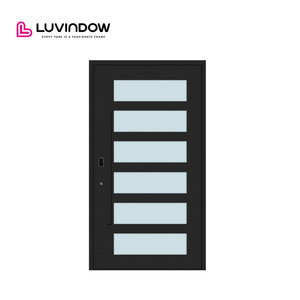
Secure Large Opening Aluminum Entry Pivot Doors for High End North American Residential Communities
- 90mm Heavy Thermal Profile
- FritsJurgens Hydraulic Pivot
- Multi-Point Hook Lock
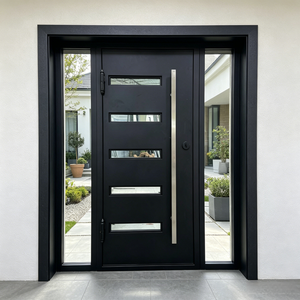
Sunnysky Oversized Aluminum Pivot Door AS2047 Certified Glazed Exterior Swing Open Hinged Grand Mansion Entrance Main Doors
- AS2047 & NFRC Certified
- 3.0mm Extrusion Wall
- Triple Glazed Low-E Glass
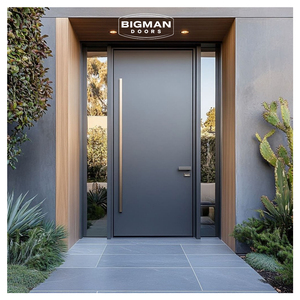
British Modern Minimalist Dark Grey Matte Security Pivot Door Heavy Metal Entry Door Anti-Theft Feature Exterior Villa Kitchen
- Matte PVDF Grey Coating
- Anti-Theft Deadbolt Core
- Flush Minimalist Design
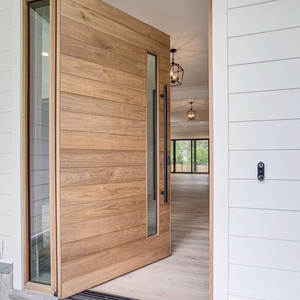
Ace Customized Direct Factory Price Wooden Frame Pivot Entrance Front Door Wood Front Entry Doors & Exterior Doors for Home
- Hybrid Wood-Alu Frame
- Factory Direct Pricing
- Concealed Floor Closer
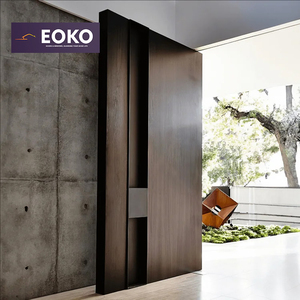
EOKO Custom Wooden Grain Front Entry Main Security Aluminum Decorous Exterior Pivot Door for America House Entrance Doors
- 3D Heat-Transfer Wood Grain
- Electromagnetic Lock Ready
- Heavy Duty Weather Sealing
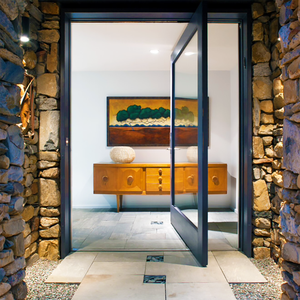
Florida Miami-Dade Approved NFRC North American Style Big Panel Tempered Glass Aluminium Modern Entry Front Pivot Doors
- Miami-Dade NOA Approved
- SGP Impact Laminated Glass
- Structural Silicone Glazing
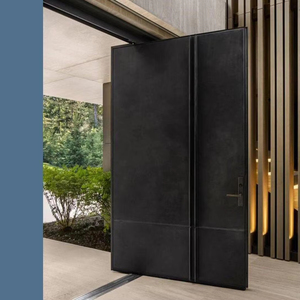
Customized High Quality Pivot Door Aluminum Pivot Door Luxurious Entry Stainless Steel Doors with Factory Price
- 316 Stainless Steel Inlays
- Integrated Vertical LED Strip
- 500kg Bearing Capacity
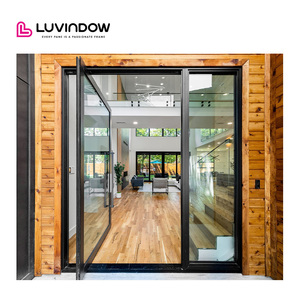
Modern Pivot Aluminum Door Glass Front Villa Entry US Made Thermal Break Energy Efficient
- Polyamide PA66-GF25 Strip
- NFRC Certified U-Factor 0.22
- Concealed Soft-Closing Hinge
Executive Summary: The Evolution of Modern Aluminium Pivot Doors in Luxury Architecture
In modern architectural design, entry doors are no longer merely functional barriers separating indoor living spaces from the exterior environment. They serve as primary architectural statements that set the aesthetic tone of luxury residential villas, grand mansions, and high-end commercial properties. Among all fenestration typologies, Aluminium Modern Pivot Doors have emerged as the gold standard for large-format grand entrances. Unlike traditional side-hinged doors that rely on wall-mounted jamb hinges, a pivot door rotates on a vertical axis anchored to the floor slab and the top head frame header. This fundamental shift in load distribution completely redefines what is architecturally achievable.
By transferring massive structural weights—often exceeding 350kg to 500kg per leaf—directly into the structural concrete floor, pivot hardware frees the door frame from rotational torque and sag. Consequently, architects can specify single-panel grand entry leaves spanning up to 2.5 meters in width and over 4.0 meters in height. Leading custom manufacturers in China, led by specialized producers such as Primor Metal Door Co., Ltd. (Primor Entry Door), have mastered the industrial precision, metallurgical extrusion, and thermal break engineering required to build these oversized architectural components at a fraction of Western production lead times and costs.
Why Extruded Aluminium Dominates Luxury Pivot Door Manufacturing
While solid timber, steel, and composite materials are historical options for exterior doors, extruded 6063-T6 and 6060-T66 architectural aluminium alloy has established unquestioned supremacy in high-performance pivot door manufacturing. The technical rationale includes:
- Dimensional Stability & Anti-Warping: Large natural wood doors suffer from severe thermal expansion, moisture absorption, and bowing when exposed to unequal interior/exterior temperatures. High-grade extruded aluminium profiles maintain millimeter-perfect structural rigidity under extreme thermal stress.
- Heavy-Load Structural Ribbing: Precision aluminum extrusions incorporate internal chambered ribbing with profile wall thicknesses ranging from 2.5mm to 3.5mm at critical hardware anchoring points, ensuring zero flex when carrying heavy double or triple-glazed Low-E insulated glass units.
- Advanced Surface Finishing: Aluminium supports premium exterior surface treatments including AkzoNobel electrostatic powder coating, PVDF fluorocarbon coatings for oceanfront marine environments, and 3D thermal transfer wood-grain finishes that match the organic warmth of timber without the maintenance overhead.
Why Global Builders Specify Primor Metal Door Co., Ltd.
Factory-direct OEM manufacturing backed by in-house CAD/BIM shop drawing approval, international code compliance, and a dedicated North American showroom network.
Engineered Thermal Break Systems
Our profile systems integrate high-density Polyamide PA66-GF25 structural thermal barrier strips, effectively isolating interior and exterior metal sections to prevent thermal bridging and interior condensation.
U.S. Local Showroom Network
Project managers, architects, and importers can inspect full-size operational displays and profile samples at our five U.S. regional centers in Los Angeles, the Bay Area, Houston, Dallas, and Phoenix.
BIM & Shop Drawing Workflow
Every order undergoes rigorous engineering review. We generate millimeter-accurate CAD shop drawings detailing rough openings, hardware offset positions, floor box drop depths, and glass specs before cutting.
International Code Certifications
Our pivot entry systems are engineered and tested to satisfy rigorous global fenestration standards, including Australian AS2047, North American NFRC thermal standards, and Florida Miami-Dade High Velocity Hurricane Zone (HVHZ) impact ratings.
European Hardware Integration
We work seamlessly with premier hardware partners such as FritsJurgens (System M+ / System One), Dormakaba, and custom German multi-point motorized locking gear for fluid, silent, finger-touch operation.
Export-Ready Heavy Wooden Crating
Export units are individually wrapped in vapor-barrier foils, fitted with steel-reinforced corner guards, and secured inside custom ISPM-15 heat-treated plywood crates for damage-free ocean container shipping.
Future Technological & Procurement Trends (2026–2030)
As architectural demands lean heavily toward ultra-modern minimalism and smart living, the manufacturing landscape for custom aluminum pivot doors is evolving rapidly.
1. Smart Biometric & Motorized Lock Integration
Standard mechanical keys are rapidly giving way to smart access ecosystems. Future-ready pivot doors incorporate hidden motorized multi-point lock actuators driven by flush-mounted biometric sensors, facial recognition cameras, and smart home automation protocols (KNX, Zigbee, Control4).
2. Aerogel & Ultra-Low U-Value Thermal Insulation
Energy codes across North America (IECC) and Europe (EnEV) are mandating increasingly stringent building envelopes. Manufacturers are deploying aerogel-filled aluminum extrusion cavities combined with 25mm–34mm PA66-GF25 thermal breaks to achieve total system U-factors below 0.18 BTU/h·ft²·°F.
3. Super-Sized Glass Panels & Minimalist Sightlines
The contemporary aesthetic demands maximum glass area with minimal visible framing. Advanced structural silicone bonding allows narrow 20mm perimeter sightlines capable of supporting 12mm+12mm SGP laminated low-iron tempered glass panels reaching heights up to 5.0 meters.
4. Active Drop-Down Perimeter Weather Sealing
Historically, bottom water infiltration was a vulnerability for pivot doors due to floor clearance requirements. Next-generation Chinese manufacturing incorporates dual automatic pneumatic drop-down bottom seals and magnetic weather-stripping that compress tightly upon closure.
5. Direct Factory OEM Sourcing & Digital Twin BIM
Global developers and importers are bypassing regional distributors to partner directly with China manufacturers. Using BIM models and 3D digital twins, project teams test clearance tolerances, structural anchoring, and wind loads virtually before physical fabrication begins.
6. Sustainable Low-Carbon Aluminum Billets
With ESG compliance becoming mandatory for institutional builders, leading extruders are utilizing hydro-powered recycled aluminum billets, reducing embedded carbon footprints by up to 70% while maintaining 6063-T6 tensile strength specs.
Technical Specifications Matrix: Modern Pivot Systems vs. Traditional Entry Doors
To assist architects, structural engineers, and procurement managers in selecting the ideal entrance system, the following data table compares key performance parameters across primary entry door configurations.
| Performance Metric | Thermal Break Aluminium Pivot Door | Standard Side-Hinged Aluminium Door | Solid Timber Entry Door |
|---|---|---|---|
| Max Leaf Width | Up to 2500 mm (8.2 ft) | 1100 mm (3.6 ft) | 1200 mm (3.9 ft) |
| Max Leaf Height | Up to 5000 mm (16.4 ft) | 3000 mm (9.8 ft) | 2700 mm (8.8 ft) |
| Hinge Weight Limit | 500 kg+ (Floor Loaded) | 120 kg (Jamb Loaded) | 150 kg (Jamb Loaded) |
| Thermal Performance (U-Factor) | 0.18 – 0.24 (PA66-GF25) | 0.28 – 0.35 | 0.32 – 0.45 |
| Wind Load Resistance | Up to 5000 Pa (Miami-Dade HVHZ) | 2400 Pa | 1800 Pa |
| Dimensional Bowing Risk | Zero (Extruded Alloy 6063-T6) | Low | High (Vulnerable to humidity) |
Frequently Asked Sourcing & Engineering Questions
Clear answers to critical technical questions asked by architects, general contractors, and overseas importers when ordering custom aluminum pivot doors from China.
What is the structural advantage of a floor-anchored pivot system over traditional side hinges?
Traditional side hinges concentrate all door leaf weight and rotational leverage onto the vertical side jamb of the frame, causing wall flex and sagging over time on leaves wider than 1.1 meters. A floor-anchored pivot system transfers 100% of the door's vertical dead load directly down into the structural concrete floor slab. The top pivot point acts purely as a stabilizing guide, allowing massive single-panel widths (up to 2.5m) and weights (500kg+) to rotate effortlessly with zero frame distortion.
How do thermal break aluminum profiles prevent heat loss and condensation?
Aluminum is a naturally conductive metal. Non-thermal aluminum frames transfer exterior cold or heat into the building interior, causing energy loss and moisture condensation. A thermal break profile utilizes a precision-extruded Polyamide barrier (PA66-GF25 reinforced with 25% glass fiber) that mechanically joins the separate interior and exterior aluminum profiles. This low-conductive polyamide strip breaks the thermal pathway, dropping the total window U-factor significantly and preventing indoor condensation in harsh winter climates.
How are pivot doors weather-sealed at the bottom where floor clearance is required?
Primor entry pivot doors utilize advanced dual-seal weather-stripping technology. When the door leaf is open, a concealed drop-down bottom seal sits retracted inside the lower door profile. As the door leaf reaches the fully closed position, an integrated mechanical plunger activates, driving high-density EPDM rubber weather strips downward against the stainless steel threshold. Combined with perimeter continuous magnetic seal gaskets, this creates an air- and water-tight barrier against wind-driven rain.
Can Chinese aluminium pivot doors meet North American NFRC and Florida Miami-Dade hurricane standards?
Yes. Specialized manufacturers like Primor engineer specific product lines tailored for strict export code compliance. For hurricane zones such as Coastal Florida or the Caribbean, doors are built using heavy-wall extrusions (3.0mm+), structural silicone glazing (Dow Corning 995), and SGP interlayer laminated impact glass tested to withstand missile impact (TAS 201/203) and high wind pressures exceeding 5000 Pa under Miami-Dade NOA guidelines.
What pivot hardware brands are used, and can clients specify custom floor springs?
Our aluminum door profiles are precision CNC-milled to accommodate top-tier global pivot hardware. We regularly integrate Dutch FritsJurgens systems (System M+, System One, System 3), German Dormakaba BTS series floor springs, and custom heavy-duty concealed hydraulic floor closers with adjustable hold-open angles (90° or 180°), soft-close damping, and 3D spatial alignment capabilities.
What is the standard production lead time and CAD approval process for overseas projects?
Once project drawings or schedules are submitted, our engineering department generates comprehensive CAD shop drawings within 3 to 5 business days for client approval. Manufacturing typically requires 25 to 35 calendar days following CAD sign-off and color sample confirmation. Orders are then pre-assembled and 100% factory tested before being packed into steel-reinforced plywood crates for ocean shipping.
Ready to Elevate Your Architectural Opening?
Partner with China’s premier custom aluminium window and door manufacturer. Share your project floor plans or door schedule with our technical engineering team for immediate review, shop drawings, and competitive direct factory pricing.
Send an Inquiry