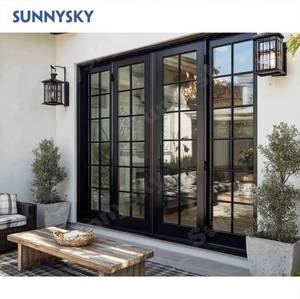
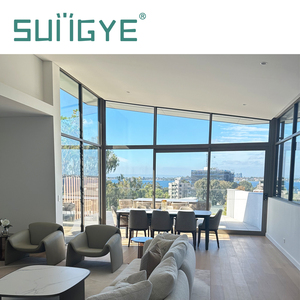
Factory-direct high-performance entrance systems engineered specifically to withstand severe marine environments, salt spray corrosion, and hurricane-force wind loads.
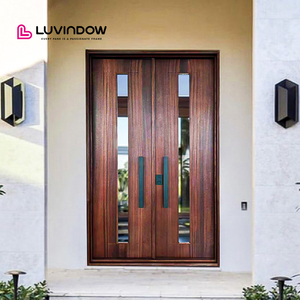
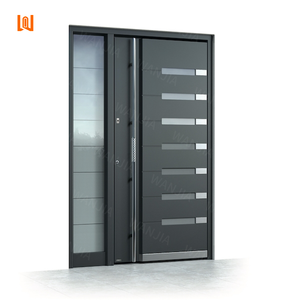
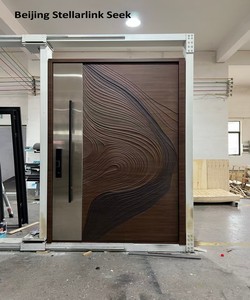
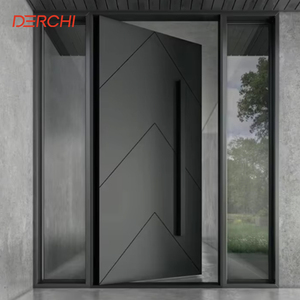
USA Villa Modern Exterior Solid Wood & Pivot Aluminum Entry Door
Heavy-Duty PivotThermal Break
Designed for luxury coastal villas featuring heavy-duty offset pivot hardware, PA66GF25 thermal insulation, and weather-sealed dual EPDM gaskets.
Engineering Coastal Durability: Material Metallurgy & Atmospheric Science
Building along ocean shorelines presents an exceptionally harsh environment for architectural fenestration. Marine microclimates subject front entry doors to relentless airborne chloride salts, severe solar ultraviolet irradiation, extreme wind-driven rain water pressures, and elevated thermal expansion stresses. When sourcing from China coastal aluminum entry door manufacturers and factories, structural specifiers, real estate developers, and international buyers must evaluate the underlying engineering physics to ensure structural integrity over a 30+ year lifecycle.
1. Atmospheric Chloride Salt Spray Corrosion Mechanics
Ocean fog contains dense concentrations of sodium chloride (NaCl) and magnesium chloride particles. Standard mill-finish aluminum or low-grade powder coatings experience rapid pitting corrosion when exposed to continuous moisture and airborne salts. Chloride ions penetrate surface micro-fissures, forming localized galvanic cells that degrade structural aluminum profiles.
To mitigate this, leading Chinese export factories utilize marine-grade 6063-T6 or 6061-T6 aluminum alloys subjected to rigorous chromate-free pre-treatment washing processes followed by AAMA 2605 compliant 70% PVDF (Polyvinylidene Fluoride) fluoropolymer coatings. This chemical surface barrier resists micro-cracking and maintains color retention under intense UV exposure while passing 4,000+ hours of continuous salt spray testing per ASTM B117 standards.
Engineering Insight: The Role of Alloy Temper & Wall Thickness
Coastal entry doors require structural profile wall thicknesses ranging between 2.0mm to 3.0mm, significantly exceeding standard residential interior door profiles (1.2mm–1.4mm). The T6 heat treatment temper increases tensile yield strength to $\ge 210 \text{ MPa}$, preventing frame torsion under hurricane gust loads.
Tropical storms and coastal winds generate massive positive and negative pressure forces across building facades. A failure in entry door structural deflection can rupture corner joints, dislodge glass glazing units, and compromise interior living spaces.
Design Pressure (DP) Ratings: Premium coastal entrance systems manufactured in China are engineered to meet or exceed DP50 to DP70 ratings, surviving static wind pressure loads up to $3500 \text{ Pa}$.
Pressure-Equalized Internal Drainage: Water tightness (ASTM E331) is achieved through cascading internal weeping chambers equipped with anti-backflow gravity caps that prevent storm winds from blowing water inward.
Continuous EPDM Co-extruded Seals: Multi-channel synthetic EPDM rubber gaskets maintain elastic memory across extreme seasonal temperature fluctuations, eliminating air leakage (ASTM E283).
Architectural Specification Benchmark: Standard vs. Marine-Grade Entry Doors
When evaluating supplier factory proposals, technical buyers should distinguish standard commercial-grade aluminum entrance doors from genuine coastal hurricane-resistant architectural systems:
Performance Vector
Standard Entry Door Systems
Coastal Marine-Grade Entry Systems
Extrusion Alloy & Wall Thickness
6063-T5 Alloy (1.4mm – 1.8mm Wall)
6063-T6 / 6061-T6 Heavy Alloy (2.0mm – 3.0mm Wall)
Dual-Corner Crimped Mechanical Keys with Structural Epoxy Injection
Macro Trends in Coastal Architectural Entry Door Procurement (2026–2030)
Global B2B procurement patterns for high-end residential villas, resort projects, and coastal multi-family developments are evolving rapidly. Importers, general contractors, and architectural firms sourcing from China are prioritizing four distinct technology trends:
1. Oversized Offset Pivot Systems with Concealed Hydraulics
Architectural demand has shifted from traditional side-hinged single doors toward massive grand pivot entrances reaching widths up to 2.2 meters and heights up to 4.0 meters. These systems utilize floor-recessed self-closing hydraulic pivot spindles capable of smoothly supporting panel weights exceeding 450 kg (1,000 lbs) without sagging.
Modern luxury coastal properties require seamless integration into automated smart home ecosystems. Procurement orders increasingly specify fully integrated motorized multi-point lock bodies supporting biometric fingerprint scanning, encrypted RFID, keypad PIN, and remote app access powered by backup battery modules.
3. Ultra-Slim Sightlines with Concealed Sub-Frames
To satisfy contemporary minimalist aesthetic preferences, manufacturers are engineering ultra-thin outer frame profiles paired with flush threshold sills. Drainage channels are hidden beneath architectural pavers, providing barrier-free ADA compliance while maintaining strict hurricane rain isolation performance.
4. High-Performance SGP Impact Laminated Glazing
Traditional PVB (Polyvinyl Butyral) interlayers tend to delaminate when water ingress occurs at glass edges in humid ocean climates. Advanced specifications mandate SentryGlas® (SGP) ionoplast interlayers, which are 5 times stiffer and 10 times more tear-resistant than PVB, preventing glass pane drop-out even during catastrophic hurricane impacts.
5-Step Factory Selection Protocol for Global Importers
Direct OEM/ODM sourcing from top Chinese window and door manufacturing hubs (such as Guangdong and Shandong provinces) offers unmatched cost-to-performance advantages. However, navigating quality verification requires a structured engineering evaluation:
01
Drawing Verification
Require detailed CAD/BIM shop drawings indicating wall thickness tolerances and thermal barrier placement before signing contracts.
02
Alloy Certification
Verify mill test reports for 6063-T6 aluminum alloy composition and AAMA 2605 coating thickness test records.
03
Structural Corner QC
Ensure corner joints use pneumatic crimping machines with dual-component polyurethane sealant injection for waterproof joints.
04
Water Testing Tanks
Request factory video testing of full-scale mock-up units under simulated rain spray pressure rigs prior to mass production.
05
Export Packaging
Mandate fully enclosed fumigated plywood crates with protective corner guards, plastic moisture wrap, and desiccant bags.
Why Partner with Primor Metal Door Co., Ltd.
Primor Metal Door Co., Ltd. stands as an industry leader in custom architectural aluminum fenestration. Built around project-specific drawings rather than standard catalog sizes, Primor delivers engineered thermal break window systems, entrance doors, pergolas, and sunrooms tailored for high-end B2B construction projects across North America, Australia, and Europe.
Direct Factory Precision & Engineering Support
Every project begins with a dedicated engineering review. Our technical team evaluates your project drawings, structural wind load constraints, U-factor targets, and glass schedules, issuing comprehensive shop drawings for sign-off prior to production.
Integrated Thermal & Impact Certifications
Primor systems are engineered to satisfy stringent international building codes, offering options compliant with NFRC thermal performance ratings, AAMA quality standards, and Florida Building Code (FBC) hurricane impact testing requirements.
Direct Local Showroom Support Network
Architects, builders, and importers can inspect full-size product displays, profile cutaways, and hardware finishes across our regional showroom locations:
Los Angeles Showroom347 Stimson Ave, City of Industry, CA 91744
Bay Area Showroom33508 Central Ave, Union City, CA 94587
Houston Showroom12510 W Airport Blvd, Sugar Land, TX 77478
Direct technical answers to common questions raised by developers, architectural specifiers, and procurement officers sourcing coastal aluminum entry doors from China.
1. What makes an aluminum entry door coastal marine-grade?
A coastal marine-grade aluminum entry door incorporates three critical engineering factors: 1) Material Selection: Utilizing heavy-wall 6063-T6 structural aluminum alloy; 2) Superior Surface Finish: Applying 70% PVDF fluoropolymer paint compliant with AAMA 2605 standards to resist 4,000+ hours of ASTM B117 salt spray exposure; and 3) Hardware Metallurgy: Incorporating 316-grade stainless steel hinges, handles, and lock components to eliminate galvanic pitting corrosion.
2. How do polyamide thermal break strips improve coastal door performance?
Aluminum is a highly conductive metal ($k \approx 160 \text{ W/m}\cdot\text{K}$). Polyamide thermal break strips (such as PA66GF25) isolate the exterior aluminum extrusion from the interior frame ($k \approx 0.3 \text{ W/m}\cdot\text{K}$). In warm coastal climates, this prevents ambient solar heat from transferring into air-conditioned interior living spaces, significantly reducing HVAC energy consumption and preventing indoor frame condensation.
3. What is the difference between PVB and SGP laminated glass for coastal hurricane zones?
While standard PVB (Polyvinyl Butyral) interlayers provide basic safety glass performance, SGP (SentryGlas® Ionoplast) interlayers offer 5 times the tear strength and nearly 100 times the rigidity. Under extreme hurricane wind pressures or wind-borne debris impact, SGP glass remains upright and intact within the door frame even if both glass lites shatter, whereas PVB can flex, crease, and tear loose from glass channels.
4. Can China factories manufacture aluminum entry doors to custom architectural sizes?
Yes. Premier factories operate on a 100% made-to-measure production model. Based on architect drawings, CAD elevations, or rough opening schedules, engineers create detailed shop drawings for size, frame depth, glass composition, mullion location, finish color, and locking hardware. Production begins only after formal buyer approval of the CAD drawings.
5. What packaging measures prevent damage during international ocean freight shipping?
Export-ready entry doors are wrapped in PE protective film, foam edge buffers, and waterproof shrink wrap. Units are secured inside solid, fully enclosed fumigated plywood wooden crates with internal timber bracing and desiccant packs. Crates are clearly labeled according to window schedules and opening tags to facilitate organized on-site installation.
6. What documentation is required to initiate a B2B factory quote?
To receive an accurate engineering proposal and unit price breakdown, buyers should provide: 1) Architectural drawings or door schedule with dimensions; 2) Project location (to determine wind load & DP requirement); 3) Frame color & coating type; 4) Glass specs (e.g., Low-E double glazed or impact laminated); and 5) Target hardware/smart lock requirements.
Start Your Coastal Project Consultation Today
Contact our engineering team to review your architectural drawings, receive custom CAD shop drawings, and request competitive factory-direct pricing for high-performance coastal entry doors.