Top-Rated Modern Aluminum Entry & Exterior Doors
Engineered to precision with PA66 thermal break technology, 6063-T5 architectural grade extrusions, and multi-point security hardware for overseas project compliance.
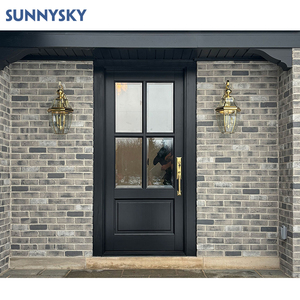
Sunnysky Modern American Design House Entrance Front Pivot Door Front Entry Pivot Doors
Engineered for grand residential entryways, featuring heavy-duty offset floor pivot hardware supporting leaf weights up to 450kg with perimeter brush compression seals.
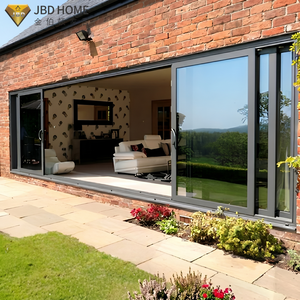
Modern Exterior 4 Panel Aluminum Sliding Glass Door Double Glazed Tempered Patio Entrance For Residential Villa Projects
Quad-panel wide-span patio entrance system designed with dual PA66 insulation strips, stainless tandem rollers, and low-profile barrier-free drainage sill options.
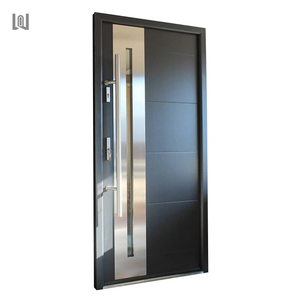
Wholesaler Bulk Factory Direct Sales Modern Aluminum Exterior Front Entrance Security Door for Apartment Use Fire Resistance
Bulk procurement security entrance door engineered with intumescent fire seals, reinforced steel core plates, and acoustic insulation for multi-unit apartment complexes.
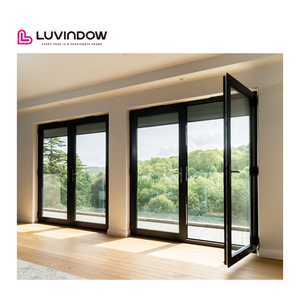
Premium Double Glass Entry Doors Coastal Home Exteriors Swing Style Aluminum Alloy Hurricane-Resistant & Premium Quality
High-velocity hurricane zone (HVHZ) certified swing entrance door built with 3.0mm structural wall profiles, marine-grade PVDF coating, and impact safety glass.
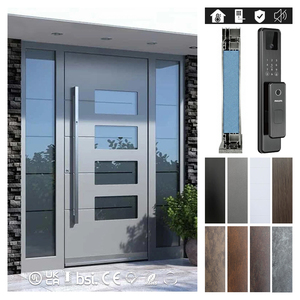
British Detached House Modern High Strength Matte Gray Finish Stainless Steel Tempered Glass Security Door with Double Sidelite
European-inspired entrance facade package featuring a central thermal break aluminum door flanked by double tempered frosted sidelites for maximum natural foyer daylighting.
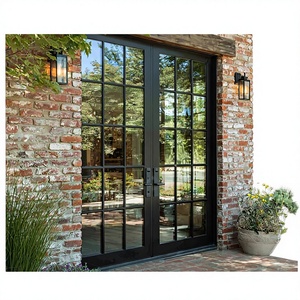
Sunnysky French Style Exterior Entry Double Tempered Glass Waterproof Modern Retro Black Aluminum Swing Door
Architectural retro-styled black aluminum swing door combining minimal sightline mullions with high-density EPDM triple weatherstripping for complete wind-driven rain resistance.
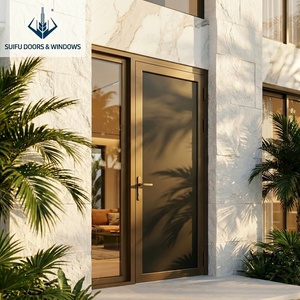
French Style Aluminum Alloy Swing Front Entry Door AS2047 Double Glazed Hurricane Proof Entrance Door
Fully certified under Australian AS2047 standards, featuring heavy-duty 3D adjustable hinges, argon-filled double Low-E glass, and high structural air/water tightness ratings.
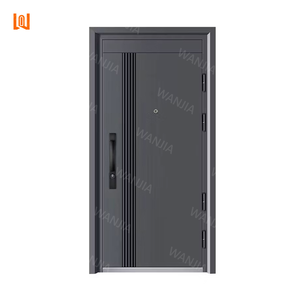
New Design Wholesale Exterior Front Entry Door House Entry Security Door Metal Main Aluminum Door
Contemporary main entry door with custom CNC geometric grooved aluminum face panels, integrated vertical ambient LED pull handles, and keyless biometric entry integration.
Executive Overview: China’s Dominance in Modern Aluminum Entry Door Export
In global architectural engineering and commercial real estate development, the specification of main entrance doors has undergone a radical paradigm shift over the past decade. Traditional solid timber, hollow metal steel, and fiberglass entrance systems are increasingly being superseded by extruded thermal break aluminum alloy door systems. The reason for this global transition lies in the superior strength-to-weight ratio, structural stability, weather resistance, design versatility, and lifecycle cost-efficiency offered by modern aluminum metallurgy.
China has firmly established itself as the world’s foremost hub for high-end architectural aluminum extrusion, CNC machining, and door system manufacturing—concentrated heavily in world-class industrial clusters such as Foshan, Guangdong. Importers, developers, architects, and general contractors seeking China best modern aluminum front door factories & exporters are no longer merely looking for low-cost contract manufacturing; they are seeking strategic B2B engineering partners capable of delivering customized, code-compliant, and high-performance building envelope components.
This technical whitepaper provides an exhaustive analysis of the engineering parameters, material science, future procurement trends, compliance standards, and factory evaluation methodologies necessary to successfully source premium aluminum front doors directly from top-tier Chinese exporters.
Engineering Mastery: Thermal Breaks, Alloy Metallurgy & Structural Mechanics
Evaluating the internal physics and structural engineering of modern entrance doors.
6063-T5 vs 6061-T6 Aluminum Alloy
Top Chinese exporters utilize primary 6063-T5 aluminum extrusions with nominal profile wall thicknesses ranging from 2.0mm to 3.0mm for structural door leaves. T5 artificial aging treatment ensures optimal tensile strength (minimum 185 MPa) while preserving elastic malleability for complex CNC profile geometry and precision corner crimping.
PA66-GF25 Polyamide Thermal Strips
Aluminum is inherently conductive (thermal conductivity ~200 W/m·K). Premium thermal break front doors incorporate PA66 polyamide insulated strips reinforced with 25% glass fiber. This interrupts conductive heat transfer through the aluminum frame, cutting door overall U-factors down to 1.3 - 1.6 W/m²K and preventing interior condensation in harsh winter climates.
Multi-Point European Hardware Locks
Security integrity is determined by lock gear mechanism integration. Leading factories partner with world-renowned hardware manufacturers (G-U, Hoppe, Siegenia, Roto) to integrate 3-point to 5-point automatic security deadbolts. Continuous perimeter EPDM gaskets ensure air tightness class 4 (EN 12207) and water tightness up to Class 9A.
Future Sourcing & Product Development Trends (2026–2030)
What global architects, estate developers, and building material importers must anticipate when specifying aluminum front doors for upcoming project pipelines.
1. Oversized Heavy-Duty Pivot Entrance Systems
Architectural demand is moving rapidly away from standard 900mm wide doors toward oversized pivot entrance doors reaching heights of 3.5 to 5.0 meters and widths up to 2.0 meters. Specialized floor-embedded hydraulic pivot hinges with adjustable dampening are fast becoming standard specification items.
2. Keyless Biometric & Smart Home Automation
Factory-integrated motorized locking devices compatible with 3D facial recognition, biometric fingerprint sensors, smartphone BLE/Wi-Fi modules, and home automation protocols (KNX, Control4, Zigbee) are expected in over 65% of high-end export doors by 2028.
3. Qualicoat Class 2 & PVDF Surface Longevity
In coastal and high-UV environments, standard powder coatings fade within 3-5 years. Global specifiers are enforcing Qualicoat Class 2 super-durable powder coatings or 3-coat fluorocarbon PVDF finishes offering 20+ year chalking and color retention guarantees.
4. Extreme Coastal Hurricane & Impact Resilience
With volatile global weather patterns, importers in North America (Florida HVHZ), Australia (Cyclonic Regions), and the Caribbean require impact-tested laminated glass (SentryGlas® ionoplast interlayers) rated to withstand structural wind loads exceeding 5000 Pa (ASTM E1886 / E1996).
5. Decarbonized & Low-Carbon Recycled Extrusions
ESG compliance is pushing factories to adopt hydro-powered low-carbon aluminum billets with Environmental Product Declarations (EPD) to assist developers in earning LEED v4 and BREEAM green building certifications.
Entrance Door Material Comparative Matrix
A rigorous engineering comparison of front door substrates for commercial and high-end residential applications.
| Performance Parameter | Thermal Break Aluminum | Solid Natural Timber | Armored Steel Sheet | Fiberglass Composite |
|---|---|---|---|---|
| Structural Rigidity & Span Limit | Exceptional (Up to 5.0m Height) | Moderate (Prone to warping >2.4m) | High (Limited design flexibility) | Moderate (Fixed mold sizes) |
| Weather & Moisture Resistance | Immune to Rot, Corrosion & Swelling | Poor (Requires periodic resealing) | Moderate (Prone to rust if scratched) | Excellent (Non-corrosive) |
| Thermal U-Factor Performance | 1.2 – 1.6 W/m²K (PA66 Insulated) | 1.4 – 1.8 W/m²K | 2.2 – 3.5 W/m²K (Cold Bridges) | 1.3 – 1.7 W/m²K |
| Burglary Security Rating | RC2 / RC3 / PAS 24 Compliant | RC1 / Basic Deadbolt | RC3 / Armored Multi-Point | RC1 / RC2 |
| Surface Finish Lifespan | 20–30 Years (PVDF / Qualicoat) | 3–5 Years (Refinishing needed) | 8–12 Years (Powder Coat) | 10–15 Years (Painted) |
| Recyclability & Circularity | 100% Infinitely Recyclable | Biodegradable (If untreated) | 100% Recyclable | Non-Recyclable (Landfill) |
Why Specifiers & Importers Partner with Primor Metal Door Co., Ltd.
As a leading Chinese custom manufacturer of aluminum windows, entry doors, sliding systems, pergolas, and thermal break sunrooms, Primor Metal Door Co., Ltd. bridges the gap between Asian manufacturing scale and Western engineering precision.
-
✓
100% Custom Shop Drawing Approval: Every order undergoes rigorous engineering review. Detailed 2D/3D CAD shop drawings and BIM models are issued for client sign-off before raw profile cutting.
-
✓
Strict Quality Control & Pre-Assembly Mock-ups: 100% of manufactured door frames and panels undergo factory mock-up assembly, seal compression checking, and hardware cycle testing prior to crating.
-
✓
Export-Ready Protective Packaging: All units are individual-labeled by building opening code, wrapped in moisture barrier film, corner-protected, and encased in fully sealed ocean-freight wooden crates.
-
✓
Global Testing & Certification Compliance: Systems engineered to satisfy NFRC energy ratings, Florida Product Approval wind loads, Australian AS2047 standard, and European CE mark requirements.
U.S. Local Support & Showroom Network
Overcoming the traditional barriers of overseas sourcing, Primor provides direct local product representation, full-size physical display inspection, and physical profile sample validation across major U.S. commercial hubs:
Frequently Asked Questions for B2B Importers & Contractors
Essential technical and logistical answers for overseas buyers sourcing modern aluminum front doors from China factories.
Can Chinese aluminum front door factories manufacture to custom sizes and CAD drawings?
Yes, premium manufacturers like Primor operate entirely on a custom made-to-measure production model. Rather than forcing clients into restricted stock catalog dimensions, every door leaf, outer frame, transom, and sidelite is precision-milled via multi-axis CNC machinery based on architectural drawings or site rough opening schedules. Shop drawings are confirmed prior to extrusion cutting.
What is a thermal break aluminum front door and why is it mandatory for modern builds?
A thermal break door incorporates an extruded low-conductivity polyamide (PA66-GF25) structural strip situated between the interior and exterior aluminum profile halves. This thermal barrier prevents heat energy from conducting through the metallic frame. Combined with insulated Low-E double or triple glazing, it drastically lowers heating and cooling costs, prevents frame sweating, and fulfills modern energy code requirements (e.g., California Title 24, IECC, European NZEB).
What information is required to receive an accurate technical proposal and factory quote?
To prepare a detailed commercial and engineering proposal, importers should submit: (1) Architectural elevation drawings or window/door schedules; (2) Project geographic location and climate conditions; (3) Preferred opening style (swing, pivot, sliding) and frame color finish; (4) Glazing performance requirements (double/triple, tempered, laminated impact); and (5) Key hardware or smart lock preferences.
How do factories ensure ocean-freight cargo protection and container optimization?
Doors are disassembled into heavy-duty knockdown (KD) or pre-assembled welded frames based on site logistics. Each unit is wrapped in multi-layer protective PE film, outfitted with corner shock absorbers, and packed into ISPM-15 certified heat-treated solid wooden crates. Crates are labeled with site opening tags and loaded into 20GP or 40HQ containers using specialized forklift loading ramps to prevent shipping damage.
Can smart home electronic locks and biometric readers be factory-installed?
Absoutely. Top China factories perform precision CNC mortising for concealed wiring conduits, electric strike plates, motorized multi-point locks, and biometric keypads (fingerprint, facial recognition, RFID, Bluetooth). Smart hardware can be pre-wired and bench-tested at the factory before shipment to ensure seamless plug-and-play installation on-site.
Which surface treatments offer the highest weather resistance for coastal villa projects?
For saltwater coastal environments within 1 km of the ocean, we recommend either 3-coat PVDF (Fluorocarbon polymer resin) coatings or Qualicoat Class 2 / Class 3 super-durable architectural powder coatings. These treatments provide salt-spray resistance exceeding 3,000 to 5,000 hours under ASTM B117 testing, preventing film blistering, color fading, and aluminum filiform corrosion.
Ready to Accelerate Your Architectural Project Supply Chain?
Download our complete 2026 Aluminum Windows & Doors Architectural Catalog, request physical profile swatches, or submit your CAD drawings for a factory-direct engineering estimate within 24 hours.