Choosing the best Aluminium Entry Door is not simply a matter of selecting the thickest frame or brightest finish. Performance depends on climate, installation quality, security hardware, thermal breaks, and everyday use.
The United Nations Environment Programme’s 2024 Global Status Report for Buildings and Construction states that buildings consume about 32% of global energy. This figure places pressure on every part of the building envelope, including entrance doors. The U.S. Department of Energy also identifies doors and windows as important areas for reducing unwanted heat transfer. An aluminium frame with a continuous thermal break can help limit cold bridging, condensation, and indoor temperature loss. Not every product performs equally.
Building-science expert Dr. Joseph Lstiburek often emphasizes, “Water is the enemy of buildings.” His warning applies directly to entry doors. A beautiful door can still fail when rain enters through poor sill drainage, weak seals, or careless installation. Small details matter.
Industry guidance, including the North American Fenestration Standard (NAFS), encourages buyers to examine air leakage, water penetration, structural performance, and operating force. These tests offer useful evidence, but they do not replace practical inspection. Touch the handle. Check the threshold. Look for clean corner joints.
This guide compares insulated and non-insulated frames, glazed and solid panels, hinged and pivot designs, and finishes suited to demanding weather. It also considers security, maintenance, accessibility, and whole-life value. The answer may not be the most expensive door. Sometimes, the better choice is the quieter, simpler one, installed correctly.
Aluminium Entry Door Types: Hinged, Sliding, and Pivot Systems
What Type of Aluminium Entry Door Is Best?
Hinged, sliding, and pivot systems each suit a different entrance. Hinged aluminium doors remain the practical choice for many homes. They open through a familiar arc and usually provide strong compression around the seals. This can support better weather resistance and security when the frame is correctly installed. A reinforced hinge side also helps with heavier insulated panels. Allow enough clearance for furniture, steps, and passing traffic.
Sliding doors save valuable floor space.
Their panels move along a track instead of swinging inward. This design works well beside patios, narrow hallways, or wide garden openings. Check the track carefully. Dust, grit, and poor drainage can affect smooth movement over time. High-quality rollers and adjustable hardware matter more than appearance alone. Sliding systems may also offer less airtight sealing than hinged doors, depending on the frame design.
Pivot doors create a bold, spacious entrance.
Their central or offset pivot point distributes weight differently from traditional hinges. This allows larger door panels, but installation demands accurate structural planning. The surrounding wall must support the frame and operating forces. A pivot door can feel impressive. It can also become awkward if the swing path is underestimated. In my experience, homeowners often focus on width and overlook daily handling, wind exposure, and cleaning access. That is an avoidable mistake. Consider the building’s orientation, insulation requirements, threshold height, and local weather before choosing a system.
Compare Thermal Break and Non-Thermal-Break Aluminium Frames
What Type of Aluminium Entry Door Is Best?
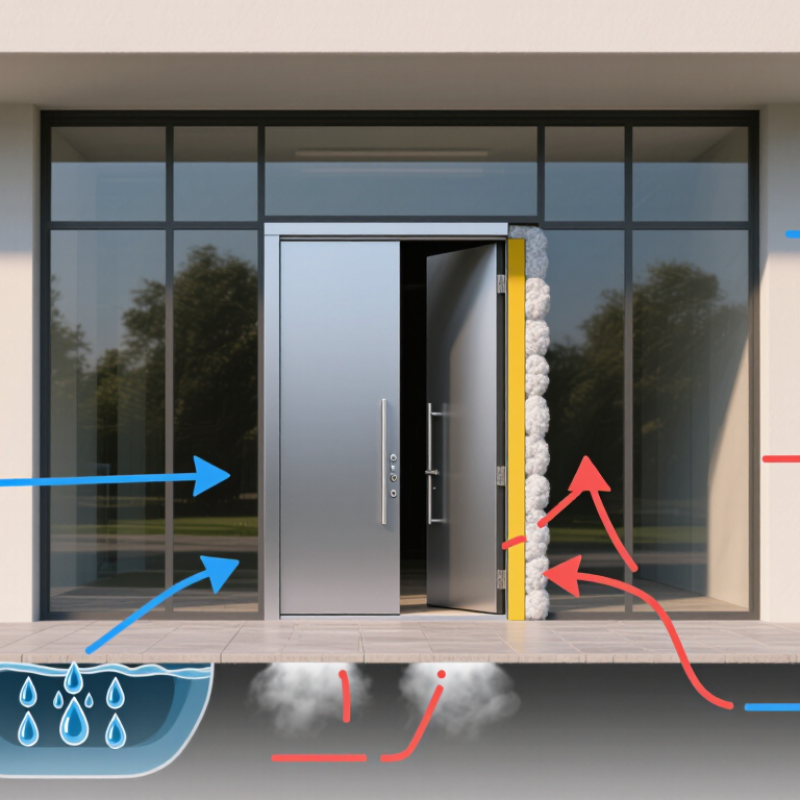
For most exposed entrances, a thermal-break aluminium frame offers stronger thermal control. It separates the inner and outer aluminium sections with a low-conductivity polyamide strip. This interrupts the direct path for heat and cold. Cold edges matter.
The U.S. Department of Energy reports that windows, doors, and skylights can account for 25–30% of household heating and cooling energy use. A better-insulated door can therefore support lower heat loss, especially beside heated rooms.
Non-thermal-break frames remain practical in mild climates, garages, storage areas, and internal entrances. They usually cost less and can provide slim, durable profiles. However, aluminium transfers heat rapidly without an insulating barrier. Condensation may appear on the inside surface during cold weather. The risk increases with high indoor humidity, poor ventilation, or weak glazing. The frame alone does not decide performance. Glass specification, weather seals, threshold design, and installation quality also matter.
NFRC guidance evaluates complete fenestration products through U-factor, air leakage, and solar heat gain measurements. These figures are more useful than judging frame material by appearance. A thermal break with badly fitted seals can underperform.
I have seen elegant doors fail at the threshold, not the frame. That detail is easy to overlook.
For a frequently used external entrance, I would normally choose a certified thermal-break system and request whole-door performance data. In a sheltered, temperate location, a non-thermal-break door may still be reasonable. The honest answer depends on climate, orientation, humidity, and budget.
Assess NFRC U-Factor Ratings for Whole-Door Energy Performance
What Type of Aluminium Entry Door Is Best?
Assess NFRC U-Factor Ratings for Whole-Door Energy Performance
The best aluminium entry door depends on climate, exposure, glazing, and installation quality. For energy performance, begin with the NFRC U-factor, not the frame material alone. A lower U-factor indicates less heat transfer through the complete door assembly. This rating usually includes the aluminium frame, panel, glass, and other tested components. It offers a more realistic comparison than judging a door by its centre panel only.
Aluminium can conduct heat quickly, so look for thermally broken frames. These frames use an insulating barrier between interior and exterior aluminium sections. However, a strong rating can still disappoint if the door is poorly fitted. Gaps around the frame may increase drafts and reduce comfort. Check the product label carefully, and confirm that the listed value represents the whole door. Some specifications may highlight glass performance instead. That difference matters.
Tips: Compare complete-door U-factors from similar sizes. Ask about air leakage testing, weatherstripping, and installation details. Inspect the threshold, corners, and frame joints during fitting. A lower U-factor is helpful, but it is not the only measure of quality. Solar heat gain, visible glass area, and local weather also deserve attention. I have found that real-world comfort often depends on small installation details. Ratings are useful, but they are not magic.
Check Air Leakage Under ASTM E283 and Weather-Resistance Tests
What Type of Aluminium Entry Door Is Best?
A thermally broken aluminium entry door is often the strongest starting point. However, air leakage deserves more attention than appearance. ASTM E283 measures air movement through a closed door under controlled pressure. The common reference pressure is 75 Pa, or 1.57 psf. Ask for the tested air-leakage rate in cfm per square foot, not only a general performance label.
Lower leakage usually means tighter gaskets, accurate corner seals, and better installation. Look for compression weatherstripping around the frame and a properly adjusted threshold. Small gaps can become obvious on a windy day. A simple smoke pencil can reveal movement around hinges and lock edges, although laboratory testing remains more reliable. A low laboratory result is useful, but it is not the whole story.
Weather resistance also needs evidence. ASTM E331 evaluates water penetration under static pressure, while ASTM E547 uses repeated pressure cycles. These tests help expose weak joints and drainage problems. The U.S. Energy Information Administration reported that space heating and cooling represented about half of household energy use in its 2020 Residential Energy Consumption Survey. A leaky entry door can quietly increase that burden.
Do not choose by metal thickness alone. A rigid slab may still leak at the frame. Installation matters. In my view, test reports should show specimen size, pressure, leakage, and water results. Vague claims are difficult to trust. The imperfect part is field performance: settlement, worn seals, and poor sill drainage can change results after installation.
What Type of Aluminium Entry Door Is Best?
Air leakage and weather resistance should be judged from independently tested performance rather than door appearance alone. A thermally broken aluminium door with continuous compression gaskets, a multi-point lock, a sill pan, and correct installation is generally the strongest specification to investigate.
The chart shows commonly referenced pressure differentials used in North American fenestration testing: ASTM E283 air leakage testing at 75 Pa and ASTM E331 water-penetration testing at 137 Pa. These are test conditions, not universal pass/fail limits; the required rating depends on the applicable product standard, project specification, door size, exposure, and installation quality.
Match Door Configuration to Security, Climate, and Entryway Use
Choosing the best aluminium entry door starts with the doorway’s daily demands. A single hinged door suits many homes with a compact porch and a clear swing path. It is straightforward to operate and can provide a firm, weather-sealed closure when properly installed. For a narrow entrance, a sliding configuration may save space, though its track needs regular cleaning to keep grit from affecting movement. Small details matter.
Security depends on the whole assembly, not just the door material. Look for a rigid frame, a suitable multipoint locking system, and glazing designed for the intended level of protection. Check how the frame will be fixed to the surrounding wall; a strong door cannot make up for weak installation. A broad glass panel may bring daylight into a dim hallway, but consider privacy and visibility from the street before choosing it.
Climate and use shape the final choice. In cold or windy areas, ask about thermal breaks, insulated glazing, and tested air and water performance. In a sheltered, mild setting, those priorities may differ. A busy family entrance might benefit from a durable finish and a threshold that is easy to cross, while a rarely used side entrance may not need the same specification. I would not choose by appearance alone. It is easy to overlook the threshold, then notice every draught or awkward step once winter arrives. Check the opening measurements and local exposure with a qualified installer before ordering.
What Type of Aluminium Entry Door Is Best? Match Door Configuration to Security, Climate, and Entryway Use
| Door configuration |
Security considerations |
Climate and energy considerations |
Best suited to |
Planning points |
| Single hinged door |
A well-fitted frame, a secure locking system, reinforced strike areas, and suitable glazing are key. Security depends on the complete installed assembly, not the door material alone. |
Thermally broken aluminium frames and insulated glazing can help limit heat transfer. Weather seals and a properly adjusted threshold help reduce drafts and water entry. |
Most standard residential entrances, especially where the opening is limited or a straightforward layout is preferred. |
Confirm the door swing, clear opening width, threshold height, and compatibility with local accessibility and egress requirements. |
| Double hinged doors |
Both leaves need secure closing and latching. The inactive leaf typically requires flush bolts or an equivalent securing system; installation alignment is important. |
A larger perimeter and meeting stile can create additional opportunities for air leakage if seals and adjustments are poor. Choose a complete system designed for the local exposure. |
Wide entrances, moving bulky items, or homes where a broad opening is useful on occasion. |
Check that the entry has room for both leaves to swing and that the inactive leaf can be operated and secured conveniently. |
| Door with fixed sidelight |
Glazing near the lock should be selected with security in mind. Consider laminated or other appropriately tested safety glazing and a layout that limits access to interior hardware. |
More glass can increase solar heat gain or heat loss, depending on glazing type and orientation. Low-emissivity coatings and insulated glazing may improve performance. |
Entrances that need more natural light without requiring a wider operable door. |
Specify the glass performance for the climate and sun exposure; safety-glazing rules may apply near doors and in hazardous locations. |
| Door with transom |
The transom is usually fixed, but the complete frame and glazing still need suitable security and safety specifications. |
Additional glazing affects the opening's overall thermal performance. Select insulated glazing and effective seals appropriate to the climate. |
Taller entryways where daylight or a balanced architectural proportion is desired. |
Confirm structural support, overall frame dimensions, and whether direct sun through the transom could cause unwanted heat or glare. |
| Pivot door |
Security depends on the pivot hardware, frame, locking points, and tested assembly. Large or heavy leaves need correctly specified hardware and professional installation. |
Oversized leaves and less conventional sealing details can make weather control more demanding. Check tested air, water, and thermal performance for the complete system. |
Large, distinctive entrances with enough clearance for the door's swing and a design that accommodates specialist hardware. |
Allow for the pivot location and swing arc, and verify that the opening remains practical for everyday access and local egress rules. |
| Sliding entry door |
Use a system with suitable anti-lift measures and secure locking. Track condition, panel alignment, and fixed-panel retention also affect security. |
Performance varies by system; seals and track design are important because sliding doors do not use the same compression-seal arrangement as many hinged doors. |
Entrances opening onto patios or decks where a swinging leaf would take up valuable space. |
Provide clear wall space for the moving panel and keep the track clean so the door can close and lock correctly. |
Selection note: Compare documented performance for the complete door assembly, including frame, glazing, hardware, seals, and installation. Security, energy, water, and air-leakage performance vary by product and local conditions; check applicable building codes and tested ratings before specifying a door.
Conclusion
Choosing the best Aluminium Entry Door depends on how the entrance is used and the conditions it must withstand. Hinged doors offer a familiar, practical option, while sliding systems can suit areas where saving swing space is important. Pivot doors create a distinctive, wide-opening entrance but require careful planning for clearance and hardware. The right configuration should balance ease of use, available space, security needs, and the local climate.
Frame construction and verified performance ratings also matter. Thermal-break frames can help reduce heat transfer compared with non-thermal-break frames, while the NFRC U-factor provides a measure of whole-door insulation performance. Check air-leakage results tested under ASTM E283, along with relevant weather-resistance tests, to understand how well a door may limit drafts and handle exposure. Comparing these details helps identify a door that fits the entryway and delivers dependable comfort and performance.